
Unlocking the Power of Integrations with PERS: How Data and APIs Shape the Future of Customer Loyalty
In today's rapidly evolving digital landscape, businesses across sectors like tourism, hospitality, and retail are facing a common challenge: data fragmentation. From marketing platforms to CRM systems, each business utilizes multiple tools to manage customer interactions, yet these systems often fail to communicate with each other.
That’s where PERS comes in, as a modular, API-first SaaS platform designed to connect disparate systems, unify data, and drive intelligent, scalable loyalty strategies. In this article, we dive into how PERS helps businesses harness the power of integration to create seamless, personalized, and measurable customer experiences.
The Challenge: Data Silos in Today's Ecosystem
Every business collects data from a multitude of sources: CRM systems, PMS, social media platforms, IoT devices, and more. But as Chiara, our Customer Success Specialist at eXplorins, points out, “these platforms don't communicate with each other, leaving the data isolated and untapped.”
The result?
Inefficiencies in marketing
Missed opportunities in personalization
Poor measurement of engagement and loyalty
This fragmentation limits the potential of each individual system and prevents businesses from truly understanding their customers. Without data integration, personalization is superficial, and measuring campaign impact becomes nearly impossible.

2. PERS: The Key to Unlocking Data's Potential
We designed PERS with a clear objective: to unify all your customer touchpoints under one roof. This modular platform connects any system, platform, api and even IoT devices, allowing businesses to gain a 360-degree view of customer interactions and real time data. This integration turns every action into measurable business intelligence.
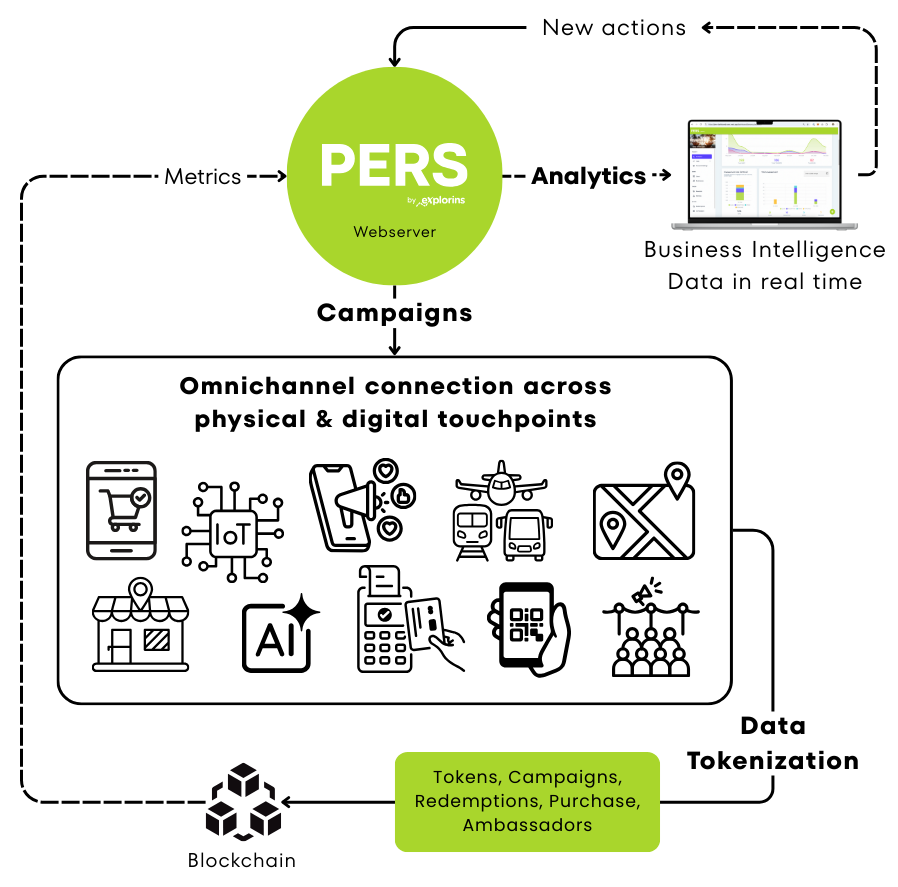
PERS levels
API-First Approach
API-first strategies have transitioned from a best practice to a competitive necessity, with over 82% of organizations now identifying as API-first to some degree. The API-first approach has evolved from a technical choice into a core business survival strategy. Modern organizations no longer treat APIs as "afterthoughts" to their software; instead, they build the API as the foundational product upon which all other interfaces (web, mobile, and AI) are constructed.
As an API-first platform, PERS allows for seamless integrations across systems. Whether you're looking to connect in order to tokenize and ready to reward, PERS is ready to integrate. This openness allows businesses to maintain flexibility and adapt to different needs and tech environments.
3. How PERS Enables Seamless Integrations
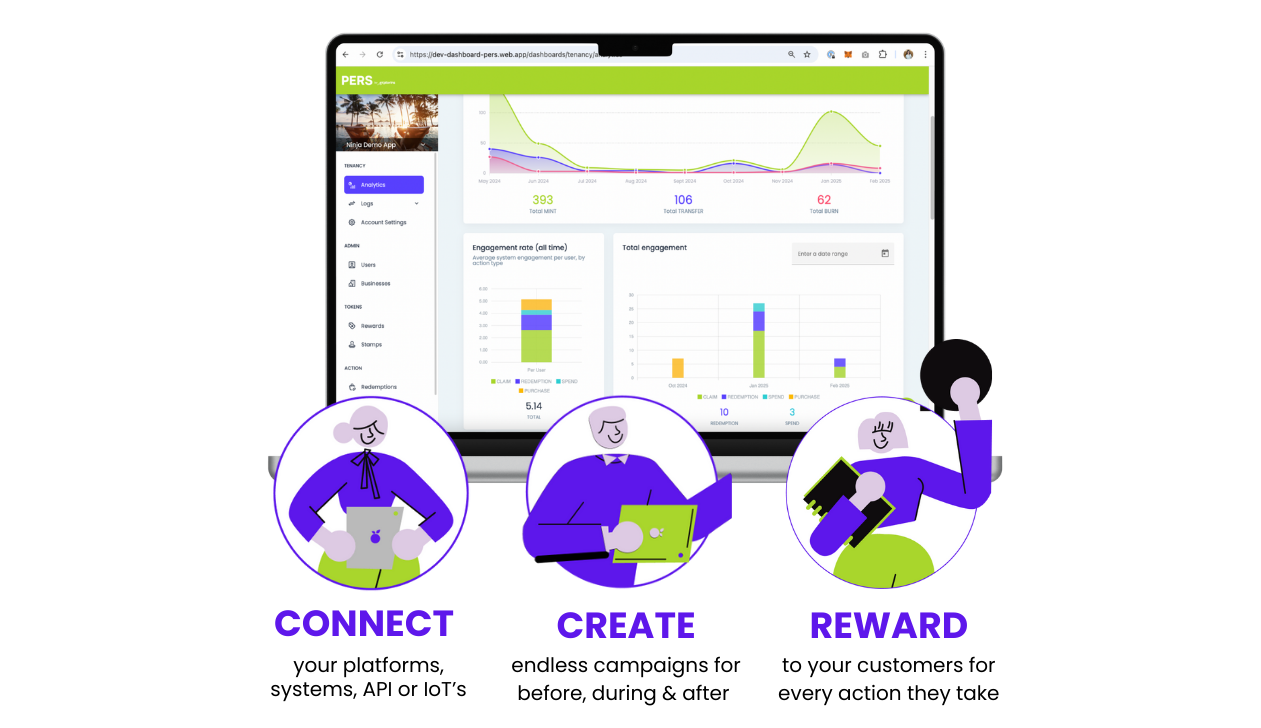
Simplified Integration: With PERS, businesses don’t need to add yet another platform into their ecosystem. Instead, PERS connects to existing systems via APIs, ensuring smooth, frictionless integration. Once integrated, data flows seamlessly between platforms, creating a unified ecosystem.
Empowering Customer Journeys: One of the most exciting features of PERS is its ability to map out the complete customer journey, from pre-visit to post-experience. By using PERS’ integration tools, businesses can connect digital touchpoints (like website visits and social media interactions) with physical experiences (such as store visits or event participation). This connectivity helps businesses create personalized, relevant experiences based on real-time data.
Data as a Business Intelligence Tool: While most platforms collect data, PERS turns that data into actionable insights. By integrating customer touchpoints into one centralized platform, businesses can use the data to:
Create personalized marketing campaigns
Reward loyal customers with timely offers
Track customer engagement across multiple channels
Measure ROI on each interaction and touchpoint
4. Claims System Flow and Real-World Examples: How PERS Powers Data-Driven Loyalty
The Claim System Flow in SaaS PERS outlines the comprehensive process through which rewards and tokens can be claimed by different entities within the system. This flow ensures that the claiming process is secure, efficient, and flexible, catering to various use cases and integration requirements.
User participation in the reward program with comprehensive security and audit features. Claim processing supports multiple access levels:
a) By User (U2M: User-2-Machine): Direct customer reward claims through authenticated user interfaces
b) By System (U2B2M: User-2-Business-2-Machine): B2B reward processing with business context attribution
c) By Business (M2M: Machine-2-Machine): Automated claims triggered by integrated platforms and APIs
To bring this concept to life, let’s look at how PERS has been used in the real world:
Example 1: Eco-Friendly Loyalty at CerdanyaViva Eco Resort
One of the standout implementations of PERS is at Cerdanya Viva Eco Resort, which uses the platform to promote sustainability through loyalty. Guests earn eco-points by making sustainable choices, like purchasing local products or using public transport, or participate in regenerative workshops. These points are then redeemable for services and experiences at the resort, reinforcing a circular loyalty model.
By integrating PERS with their Direct booking, App, PMS, and e-commerce platform, Payment system at the restaurant and shop, Cerdanya Viva seamlessly tracks every guest interaction, ensuring that sustainable actions are incentivized in real time.
Example 2: We are Tribe by PUIG – Gamifying Retail Loyalty
In retail, PERS has been instrumental in creating immersive, gamified experiences. For example, PUIG launching a Latam Campaign for Benetton’s Tribe fragrance, PERS powered a global loyalty program where users earned points through in-store activations, social media engagement, and online purchases. The campaign connected physical stores with digital channels via Pinball Game for phones and tables, enhancing customer interaction and increasing brand loyalty.
With real-time data streaming into PERS, PUIG was able to:
Track which touchpoints were most effective in driving sales
Personalize offers for repeat customers
Ensure that rewards were tailored based on user behavior
5. Why PERS is the Future of Customer Loyalty
The power of PERS lies in its ability to connect and automate customer loyalty systems across industries, from tourism to retail, hospitality, and events. The platform’s API-first architecture allows it to integrate with a range of third-party tools and services, offering unmatched flexibility and scalability.

Customer Journey with PERS
Key Benefits Include:
Reduced Cost of Acquisition (CAC): By automating loyalty campaigns, businesses can see up to 30% savings in customer acquisition costs.
Increased Retention: Businesses using PERS have seen a 25% increase in repeat visits and higher customer lifetime value (CLV).
Real-Time Analytics: PERS provides access to real-time data, which helps businesses track customer behavior and optimize their loyalty strategies effectively.
Boost Loyalty from day 1.
6. The Power of Data-Driven Personalization
As Chiara pointed out, “Integrating PERS with your systems allows you to personalize campaigns at scale, creating meaningful and measurable experiences for your customers.” This personalized approach is key to driving engagement and brand loyalty, ultimately turning each interaction into a valuable business opportunity.
With PERS, businesses can:
Collect data seamlessly across all touchpoints
Analyze behavior in real-time
Reward customers based on their actions, both digital and physical
Measure success and continuously optimize loyalty strategies
In the digital age, data is the new currency, and PERS helps businesses make the most out of every data point, transforming it into tangible results.
Watch full Webinar From Phygital Touchpoints to Data: Transforming Every Interaction into Measurable Data
Unlocking the Full Potential of Customer Loyalty
Whether you're in tourism, retail, hospitality, or any other industry, PERS is built to connect your digital and physical touchpoints, turning them into a unified loyalty ecosystem. Its open, flexible, and API-first approach ensures that businesses of all sizes can easily integrate PERS with their existing systems, unlocking the full potential of their customer data.
By creating seamless, personalized experiences, PERS enables businesses to build stronger connections with their customers and drive long-term growth.
Want to learn more about PERS and how it can revolutionize your loyalty programs?
Book a demo *
Book a demo *
-
PERS shifts loyalty from a transactional model (buy → earn) to an experience-driven ecosystem where every interaction — digital or physical — becomes a meaningful engagement moment. Unlike conventional rewards systems that rely solely on purchases, PERS integrates with CRM, PMS, POS, apps, and IoT devices to capture real behavior across the entire customer journey.
Users earn points for actions such as:
Booking directly
Participating in events
Visiting partner locations
Completing sustainable actions
Engaging with digital content
Interacting via QR, NFC, GPS, or IoT
This enables brands to create loyalty systems that reward participation, discovery, and community, not just spending. The result is higher emotional engagement, stronger retention, and a loyalty program that feels genuinely valuable, not generic.
-
PERS enhances customer experience by connecting every touchpoint into a single, continuous flow. Through API integrations, PERS ensures that users receive real-time recognition and rewards as they interact with a brand, whether they’re browsing a website, checking in at a hotel, scanning a QR code at a shop, attending an event, or using IoT-enabled services.
This creates a frictionless experience where the user feels:
Seen: the system recognizes their actions instantly
Rewarded: points and benefits update in real time
Motivated: personalized paths keep them engaged
Connected: multiple partners participate in the same ecosystem
By eliminating silos, PERS enables brands to deliver unified CX journeys that adapt to users dynamically, boosting satisfaction, simplifying onboarding, and increasing the likelihood of repeat visits and conversions.
-
Personalization requires real-time data, and traditional loyalty systems lack the infrastructure to collect and respond to it. PERS’ API-first, modular architecture solves this by integrating directly with the systems where user interactions occur, from booking engines to social media to IoT devices.
This allows brands to tailor rewards, messaging, and experiences based on:
User behavior
Location
Preferences
Visit frequency
Purchase history
Engagement level
Because PERS automates loyalty logic through triggers (user, business, system), brands can create personalized experiences at scale without increasing operational complexity.
The result is measurable improvement in:Customer lifetime value (CLV)
Retention rates
Direct revenue
Guest satisfaction
Loyalty program adoption
As customer expectations rise, API-first loyalty infrastructure becomes essential for delivering hyper-personalized, adaptive, and rewarding experiences that keep users coming back.
