
Destinations as Innovation Ecosystems: Strategy, Data & Collaboration in the Visitor Economy by Digital Tourism Think Tank
In an era where visitor behaviours, sustainability imperatives and digital acceleration converge, destinations can no longer operate in silos. If you’re a marketing or innovation manager at a DMO, operator or destination brand, this post brings you three pillars to build your innovation ecosystem, drawing on insights from our recent webinar with the Digital Tourism Think Tank.
Here’s what we’ll cover:
Why a clear strategic vision is non‑negotiable
How to turn fragmented data into actionable intelligence
Why collaboration and ecosystem design make the difference
Cases

What is a destination innovation ecosystem?
A destination innovation ecosystem is a collaborative network of public agencies, private businesses, tech providers, startups, and community stakeholders that align around a shared strategic vision for visitor economy growth. It leverages real-time data, digital platforms and co-creation to improve competitiveness and sustainability in destinations across Europe and beyond.
“Destinations are lacking the real ability to get into real-time data. Even things like telecoms or credit card data, they’re having to buy in data sets and buy a period of months rather than have that currently active all the time.””
1. Define Your North Star: Strategic Vision for the Destination
The danger of being reactive
As Nick Hall, Founder and CEO of the Digital Tourism Think Tank, emphasises, many destinations fall into the trap of reacting to short‑term trends rather than driving long‑term strategy. A solid “North Star” aligns brand, infrastructure, visitor experience, sustainability priorities and partnerships around a shared direction.

Key trends every destination must track
Sustainability (environmental, social, economic): encouraging local spend, reducing carbon impact, avoiding overtourism, and ensuring residents benefit from the visitor economy.
Digitalisation & service‑design: not technology for technology’s sake, but technology that improves journeys, reduces friction and delivers meaningful experiences.
AI & behaviour change: travellers now plan with AI tools, expect instant answers, customised recommendations and intuitive experiences. Destinations must adapt to remain relevant.
Practical take‑away
Ask: What should our destination stand for in 5–10 years? Align your ecosystem around that long‑term value rather than short‑term metrics.
2. From Fragmented to Live: Harnessing Data Across the Ecosystem
Why data is still stuck in silos
Tourism still relies on lagging indicators, monthly occupancy reports, annual surveys, outdated credit‑card or telecom datasets. These sources are valuable, but not actionable in real time. As Nick notes, destinations struggle to understand what’s happening now, not last quarter.

Turning data into utility
To unlock value, destinations need:
Real‑time signals integrated into visitor flows
API‑first platforms connecting experiences, activities, transport, F&B and accommodation
Blockchain for trust, certification and transparency
AI for insight, prediction and decision‑making
The combination of blockchain + AI creates secure, standardised, interoperable data, something the industry has been missing for decades.
Practical take‑away
Map your data landscape:
What systems talk to each other?
Which ones don’t?
Where are the real‑time gaps?
Then build an API‑driven model that fills those gaps and empowers decision‑making.
3. Build a Collaboration‑Driven Innovation Ecosystem
What is an ecosystem in destination management?
A destination ecosystem includes:
SME operators (activities, tours, F&B, accommodations)
Large tourism players
Trade partners and distribution actors
Tech companies and startups
Public agencies and cultural organisations
The DMO is not the owner of the ecosystem, it’s the orchestrator.

Why co‑creation matters?
One business alone tells a small story; 50 businesses together reveal powerful patterns. Co‑creation becomes possible when:
Data is standardized and real time metrics
Incentives are aligned
Stakeholders collaborate rather than compete
Visitors receive value (e.g., rewards) that shifts behaviour sustainably
This is where a loyalty‑driven SaaS like PERS changes the game: by enabling destinations to nudge behaviour toward sustainability, local spend or improved distribution, using reward mechanics that benefit both visitors and businesses.
Practical take‑away
Map all stakeholders
Identify shared goals (e.g., extend length of stay, promote low‑carbon choices)
Introduce a destination‑wide reward system to reinforce desired behaviours
4. Case Highlights: Interoperability, AI and Open Innovation in Action and How Data Collaboration Transforms Visitor Economy in EU?
Two destinations are already showing what it means to embed vision, data and collaboration into strategy:
Case: Visit Finland National Data Hub
Visit Finland has launched a national data‑hub that centralises tourism business data, offers free access to stakeholders, and enables API‑driven interoperability. The project aligns with the EU’s Tourism Data Space and promotes efficiency, transparency and real‑time visibility for the entire ecosystem.
Case: MarIAnne AI Travel Planner — France
France has rolled out “MarIAnne”, an AI‑based travel planner that enables hyper‑personalised visitor experiences while empowering tourism businesses through shared data layers. It was developed in partnership with startups and public actors, illustrating how co‑creation at scale leads to smarter, more sustainable destination planning.

Multilingual & accessible: The tool supports 15 languages, allowing it to reach a broad international audience. info.gouv.fr+1
Data sources & validation: MarIAnne taps into Datatourisme, which holds over 350,000 open-data activity records (accommodations, attractions, etc.). The system is designed to generate validated content and reduce typical AI “hallucinations.” info.gouv.fr+1
Innovative for a state actor: This is one of the first instances of a government entity deploying a generative-AI tool for tourism at national scale. Atout France positions MarIAnne as a bold bet on future travel agents powered by AI. info.gouv.fr
Strategic implications: Positions France at the frontier of digital tourism & innovation. Potential to promote lesser-known destinations and diversify visitor flows. The tool may evolve to integrate specialized bases (e.g. eco-tourism, accessibility), direct booking links, and deeper personalization. info.gouv.fr
Caveats & realities
Media tests show that while MarIAnne is impressive for rapid itinerary ideation, it is not flawless. For example: It sometimes proposes too many activities in one day, neglects travel distances, or picks accommodations poorly positioned relative to activities. L'Hôtellerie Restauration+2TOM.travel+2
Both cases underline a simple truth: innovation ecosystems require technical openness, stakeholder trust, and data made actionable.
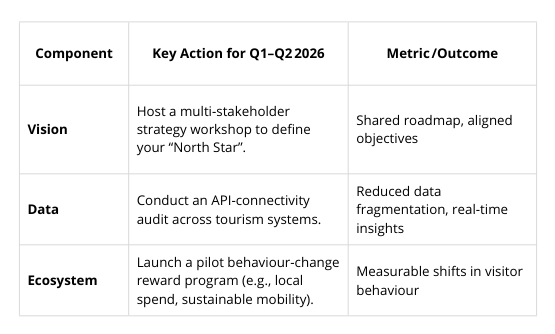
5. Bringing It Together: Your Destination Roadmap
Watch full Webinar Destinations as Innovation Ecosystems: Where Collaboration Drives Visitor Experience and Growth
Destinations that succeed won’t just attract visitors, they will build innovation ecosystems rooted in vision, powered by real‑time data and enabled by collaboration. Watch the full Webinar here:
If you’re ready to explore how PERS’s API‑first loyalty platform can unify your ecosystem and deliver measurable outcomes, book a demo and let’s build the future of destination innovation together.
“The social aspect is key because social is about making sure that residents benefit from tourism and they see the benefit of tourism. It’s making sure that the numbers you bring in actually spend and contribute economically to the well-being and the prosperity of, of people in the destination and in the economic.” - Nick (referring to the importance of social sustainability in destinations)”
Meet Digital Tourism Think Tank
The Digital Tourism Think Tank (DTTT) is a community that supports destination organizations, tourism researchers, corporations, and businesses in the tourism industry by focusing on digitalization, strategy, leadership, and sustainability. As part of the DTTT Acceleration, the DTTT program is designed to provide startups with the support and resources they need to succeed.
-
Traditional tourism data often comes from monthly reports or annual surveys — meaning destinations lack live insights. Real-time data from connected digital systems enables informed decision-making, responsive visitor services and predictive planning.
-
By analysing real-time behaviour, destinations can influence visitor choices — for example encouraging low-carbon transport, supporting local businesses, or balancing flows to reduce overtourism. Digital tools like blockchain and AI create transparent, actionable data that drives sustainable outcomes.
-
No single entity can create a thriving visitor ecosystem alone. Collaboration across SMEs, tech companies, public bodies, and hospitality businesses enables shared goals, aligned incentives and co-creation of visitor experiences that benefit residents and visitors alike.
