
How to Plug PERS Into Your Vibe Coding Solution (Case Study) White-Label Rewards Engine Integration
From concept to MVP in one week: Discover Bag Drop case study
How fast can you go from idea to MVP? Explore how Greg Martin (Artist, Creative Director and Founder of 3hree 2wo Creative based in Barcelona) built Bag Drop, a mental-health reflection WebApp. By using Lovable for the frontend and #PERS SDK's for identity, streaks, wallets, points, and reward backend infrastructure.
If you want to build fast, efficiently, and deliver meaningful user experiences without getting lost in backend complexity, this case study shows exactly how AI-powered development and plug-and-play infrastructure can accelerate your product roadmap and enhance your tech solutions.
This article breaks down how it worked.
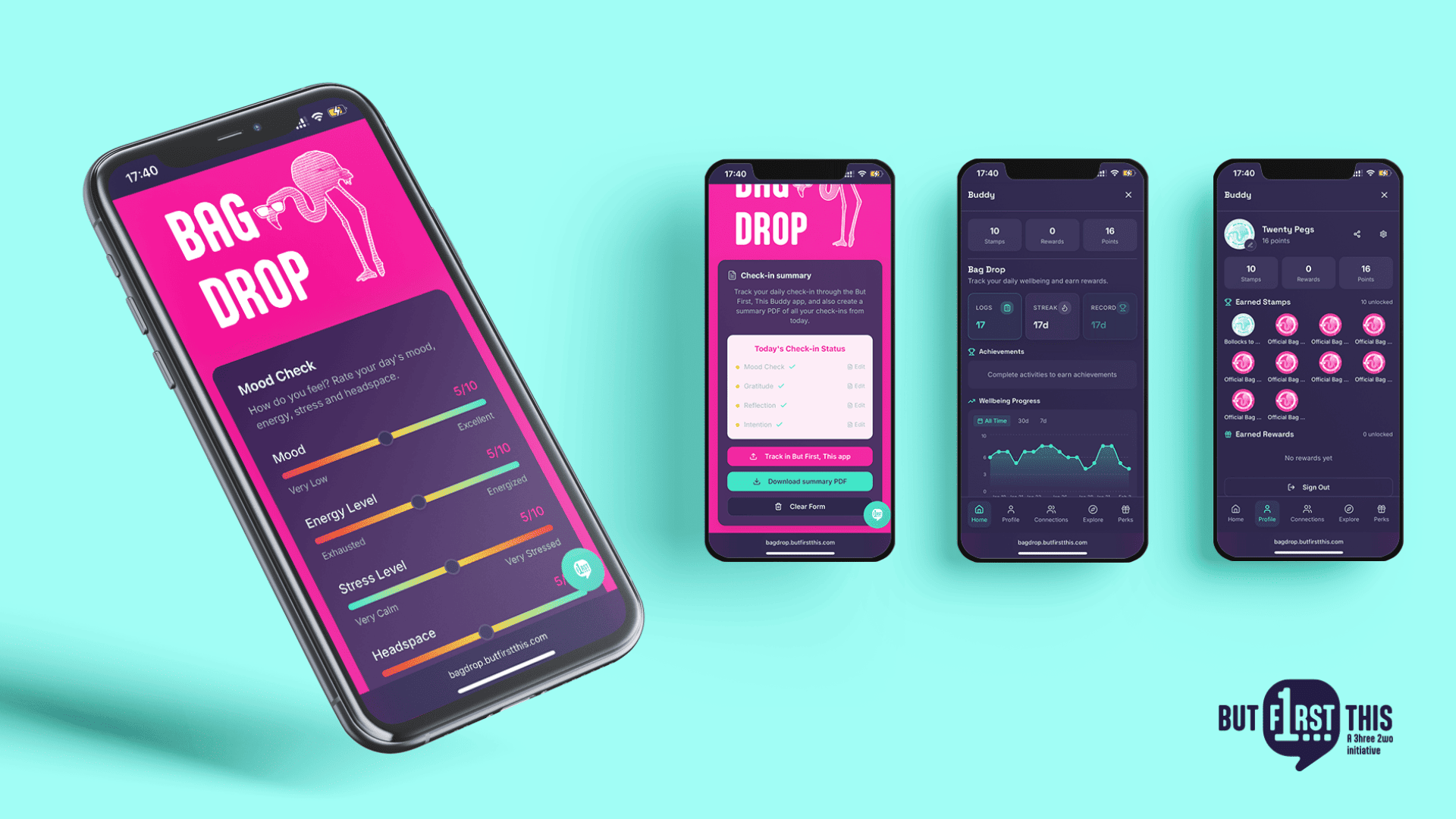
AI-powered web app builder + PERS as backend infrastructure = a functional MVP with streak tracking, reward logic, and scalable identity
·
AI-powered web app builder + PERS as backend infrastructure = a functional MVP with streak tracking, reward logic, and scalable identity ·
The Starting Point: A Personal Mental Health Routine

Greg Marting - Founder and Creative Director of 3hree 2wo Creative
Bag Drop started with a simple habit: every morning, Greg reviewed the previous day and assigned it a score between -2 and +2. Over time, he noticed patterns. Some weeks fluctuated. Some periods were consistently low. The act of tracking created awareness. That awareness helped him make adjustments.
The insight was practical: If people track how they feel, they gain clarity. If they gain clarity, they can act. Bag Drop translates that routine into a digital structure.
The core features are simple:
Mood score
Gratitude
Reflection (journaling)
Intention for the next day
Nothing complex. Just structured accountability.
The First MVP: From Simple Prototype to Working Tool by Connecting a Rewards Engine
Greg describes building Bag Drop in two phases:
Design: By using Figma Make and turned an idea and schema into a hi-fi design and test it. Focus on the core functionality: you fill in your mood, write your reflections, download the file, and that’s it. There was no login, no database, no stored history. That was intentional. The goal was to introduce the habit first, not the infrastructure.
But once he started testing it with users, the feedback was clear: People liked the structure. They found it useful. And many of them said they would like to see how their score changed over time. That small request changed the direction of the product.
Seeing progress over time means storing something. Tracking consistency means keeping data somewhere. Rewarding streaks means introducing logic.
2. Build: At that point, a static document output was no longer enough. Greg moved from a downloadable format to an interactive web app.
He used Lovable, an AI-powered web app builder, not to re-invent the product, but to speed up what he had already designed. The structure was already defined. The four sections were clear. The behavioral model was tested. AI translated that into a working interface.
Within a short time, the sliders worked. The form submissions worked. The flow started to feel real.
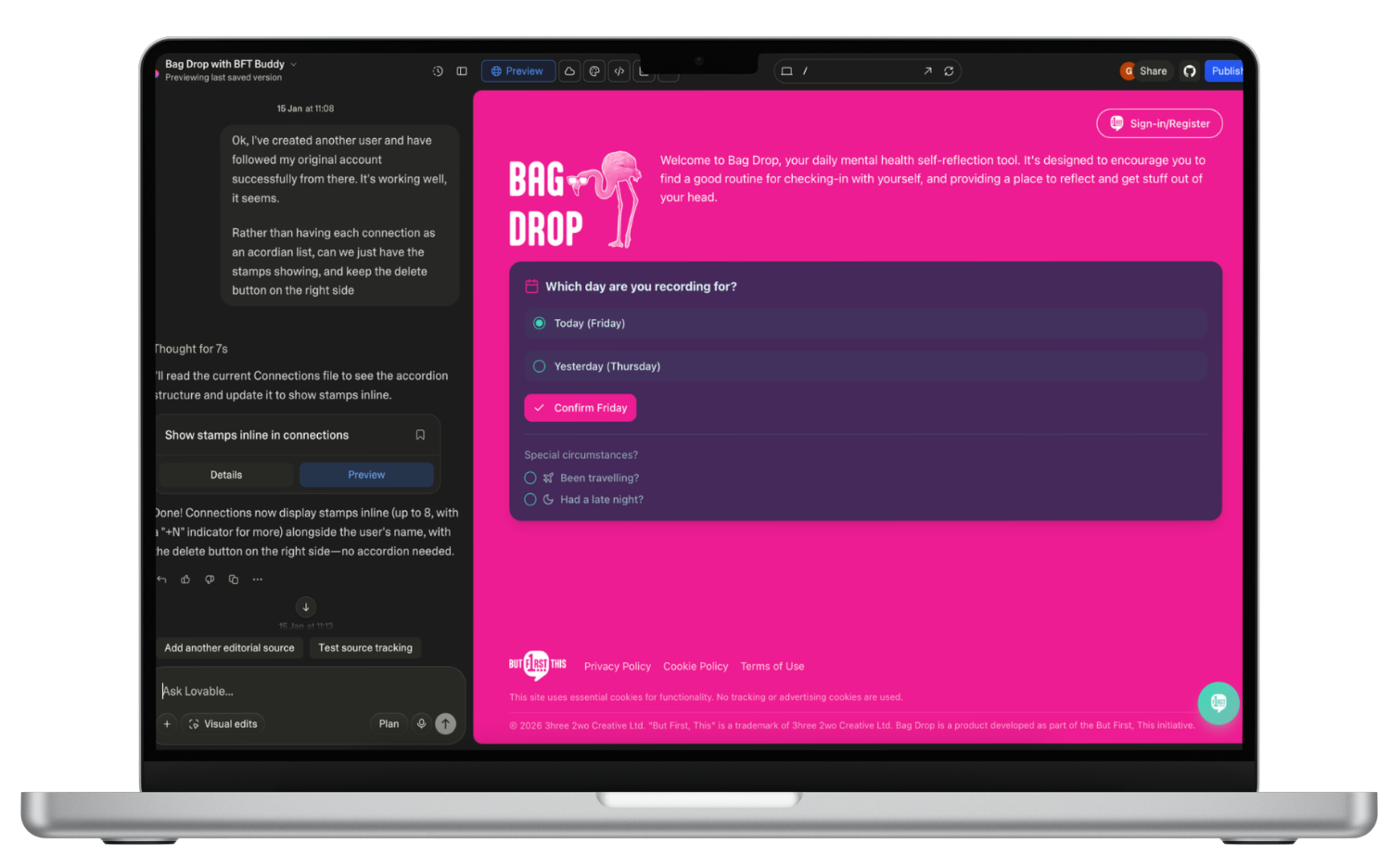
Lovable Dashboard view - Bag Drop Webapp
AI executes what you ask. If the instruction is vague, the result is vague. If the instruction is precise, the output improves. Greg quickly learned to separate discussion from execution, first clarify the logic, then allow the system to implement it.
The key shift wasn’t just speed. It was the ability to go from idea to functional MVP without hiring a developer or restructuring the entire project. That made iteration possible. And iteration is what allowed Bag Drop to evolve beyond a simple PDF into a structured digital routine.
Why Bag Drop Chose PERS as Its Backend Engine? - And What It’s Used For?

PERS API Docs & SDK
Tracking streaks and issuing rewards requires more than a frontend. From Greg’s perspective, the decision to use PERS was very clear:
Decentralized Backend for Multiple Projects
Greg wanted an “accountability buddy” system that wouldn’t be limited to Back Drop, but could power the entire collection of tools under his But First This initiative. With PERS, he can use a single backend for all his projects connect to - meaning he doesn’t have to rebuild or duplicate the architecture or logic every time a new idea emerges.Built-In Community-based Features
PERS enables community-based encouragement. Users can (with permission) view each other’s progress, celebrate milestones, and even send rewards or kudos. This social reinforcement is essential for the kind of support system Greg aims to cultivate, a space where users feel seen, encouraged, and motivated to continue their routines. Community based features are typically the more complex to integrate to an existing system, but with PERS, enhanced community interaction and participation is a plug-and-play thing.Rewards and Gamification, Made Simple
PERS naturally supports issuing streak rewards, progress stamps, and milestone badges. It also allows future integration with third-party partners, so users could potentially redeem rewards in the real world (e.g., a free coffee at a local shop). This kind of gamification is a core driver in helping users maintain healthy habits over time.Versatility and Scalability for Future Growth
Greg emphasizes that PERS is both versatile and highly scalable, two qualities that are essential as he develops more health-related micro-tools. Instead of being limited by backend constraints, he can expand organically, knowing the infrastructure will support more features, more users, and more interconnected projects.

Bag Drop WebApp view
Bag Drop needed:
User identity
Streak calculation
Milestone rewards
Future peer accountability
Scalable backend logic
PERS SDK allows to manages a robust infrastructure for:
✔ Wallet-based identity
✔ Reward issuance (stamps, points)
✔ Streak milestones
✔ Data aggregation
✔ Future integrations across other tools
Bag Drop is part of a broader initiative called But First This, a collection of health-focused tools. Using PERS means each future project can connect to the same identity and reward infrastructure.
How PERS Enables Privacy Without Sacrificing Functionality?
Most engagement or loyalty systems depend on storing personal data to authenticate users, validate actions, or issue rewards. PERS takes a fundamentally different approach. Built on a blockchain-based, decentralized infrastructure, PERS separates identity, actions, and content so creators can power rich experiences without ever accessing sensitive information.
At its core, PERS uses non-custodial identity and cryptographically signed actions to validate user behavior. This means:
The system can confirm that a user performed an action
…without needing to know who the user is
…or what personal content they wrote, felt, or shared
This is the same principle that powers modern decentralized identity systems: verify actions—never expose private data.
Because interactions are signed, verifiable, and tamper-proof, PERS allows apps like Back Drop to:
✔ Maintain streaks without storing emotional content
✔ Issue rewards and stamps without storing journal entries
✔ Track milestones without collecting personal attributes
✔ Synchronize identity across devices without passwords
✔ Guarantee data integrity without centralizing sensitive information
Blockchain becomes an invisible trust layer under the product:
Every action is recorded as a verifiable event
No personal journaling or reflections ever enter the system
Users maintain full control of what is shared or stored
The platform remains secure, transparent, and auditable
For creators like Greg, this means he can deliver meaningful engagement features: streaks, progression, accountability, rewards; without compromising the emotional safety and trust of users.
Plugging PERS White-label Reward System Into a Vibe-Coded App
From a technical standpoint, the integration worked in three steps:
Install the PERS SDK
Connect via API using the project key
Trigger reward logic from defined user actions
Lovable was able to read the PERS API documentation directly and implement it inside the web app. The documentation is human-readable and machine-readable. That reduced friction.
Scalability introduces flexibility. Flexibility sometimes requires deeper configuration. The core infrastructure remained stable.
Watch full Webinar How to Plug PERS Into Your Vibe-Coding Solution with Greg Martin Founder of 3hree 2wo Studio
Greg chose PERS because it provides a scalable, centralized, and versatile backend that supports accountability, social features, and gamification across multiple health-related projects, not just Bag drop. This allows him to build and connect new tools quickly without duplicating backend work.
Book a demo to explore PERS
Contact us here
Watch all webinars in our YouTube Channel
Join our newsletter and be the first to know about product updates and industry insights
API documentation here
Book a demo *
Book a demo *
-
Many businesses struggle to implement scalable engagement systems due to engineering costs and time constraints. The market is full of standalone loyalty apps and plugins, but these often lack customization or backend flexibility.
PERS solves this challenge as an API-first, white-label engine, enabling product teams, no-code builders and startup founders to embed powerful loyalty logic without backend buildouts.
-
Traditional programs focus on points or monetary rewards, but engagement programs today must go further. Advanced loyalty designs reward behaviors, drive ecosystem participation, and connect with partners for real world value.
PERS supports flexible models, from experiential rewards and partner redemptions to gamified milestones — making loyalty a strategic growth tool, not just a perk.
-
Many businesses build loyalty systems as addons to their digital properties, but these often require middleware or manual integration, increasing cost and complexity.
PERS is built to plug into systems via SDKs and APIs, making integration as simple as hooking identity and action triggers, whether for web, mobile, IoT, or partner channels.
-
Businesses should align rewards with business objectives (e.g., retention, cross-sell, usage frequency) and measure outcomes systematically, not only reward issuance.
With PERS, you get behavior-driven KPIs real time that tie directly to strategic outcomes, turning loyalty into a measurable competitive advantage.
-
A loyalty platform is a digital system that allows brands to design, manage, and automate reward programs that incentivize recurring engagement and valuable user actions. These systems create ecosystems where users can earn and redeem benefits based on behavior, driving long-term retention and engagement, revenue and growth, instead of one-time transactions.
With PERS, startups can launch loyalty features (points, stamps, token logic) without building backend infrastructure from scratch, turning engagement into measurable business outcomes.
